Colorado trail heads often warn about western poison ivy being near the trail and especially near moist river banks. It is a perennial shrub in the Cashew family that typically has almond shape leaves, red veins, and yellowish-white berries.
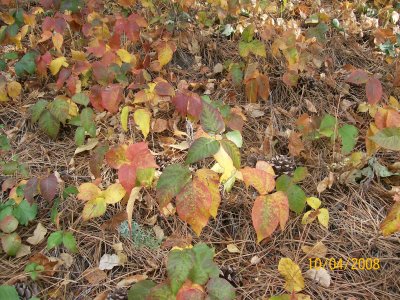
Three important notes to remember: 1) not all of the leaves on a poison ivy plant have ridges, 2) the leaves are usually but not always in leaflets of three leaves (i.e., trifoliate), and 3) during autumn the leaves turn red. Finally, each shrub is capable of growing to be nine feet tall. The following pictures show western poison ivy plants from varying distances and angles.


Western poison ivy plants secrete a milky oil called Urushiol that in liquid form or as dried residue can cause severe skin irritation (i.e., Urushiol-induced contact dermatitis). Specifically, it can cause severe skin rashes, blisters, fevers, headaches, and itching. If you think poison ivy oil or residue got on your skin then you want to immediately wash the affected area with soap, water, and/or alcohol. In addition, calamine lotion can be used to reduce itching.
If you hike with kids, please download and print our free PDFs: Poison Ivy Field Guide and Hiking Checklist for Kids.
 Two Knobby Tires